After a decade on CRAN, merTools 1.0.0 is out today.
It has been a long-term goal of mine to bring merTools to a stable state, fix outstanding bugs,
and rework the `predictInterval()` function at its core to be more modular and easy to maintain.
This release achieves that and marks the package as feature complete and the start of a
long-term-support (LTS) phase. This release hits the goal of 1.0.0 of a stable API, outstanding issues closed,
a correctness fix at the core of predictInterval(), and modularity in the core prediction interval functionality.
The documentation is also now available [via a pkgdown site as well!](https://jknowles.github.io/merTools)install.packages("merTools")
What merTools is for #
merTools has been on CRAN since 2015, with over 457,000 downloads and about
8,000 a month. It exists to get the most out of large mixed-effects models fit
with lme4
. Its headline function,
predictInterval(), produces prediction intervals for lmer/glmer models
by simulating from the joint distribution of the fixed and random effects — the
approach from Gelman and Hill (2007),1 the same machinery behind arm::sim().
The motivation is practical. lme4::bootMer() and full MCMC give you principled
uncertainty, but on models with tens of thousands of groups they can be
impractical or simply too slow to use interactively.
predictInterval()is built to give you honest intervals on exactly those models, in about a second.
Try it out and validate it against brms! #
The obvious question for a simulation-based approximation is how close it is to
doing the full Bayesian thing. When we first wrote merTools brms was in its infancy, but
since then it has become my go-to for most Bayesian inference and, frankly, made much of merTools obsolete.
I used an LLM to assist me with refactoring the code and responding to open issues, so I wanted to create a new
set of tests and benchmarks to validate that the package still worked.
So for 1.0 I created a new short vignette that compares brms and merTools results side by side:
the same data and the same model — the bundled hsb data (7,185 students in 160 schools),
modeling math achievement from student SES, school-mean SES, and a school-varying
SES slope. We hold out 20% of students to test on.
data(hsb)
hsb$schid <- factor(hsb$schid)
new_schools <- sample(levels(hsb$schid), 6)
hsb$.set <- "train"
hsb$.set[hsb$schid %in% new_schools] <- "test_new"
seen <- which(hsb$.set == "train")
hsb$.set[sample(seen, round(0.2 * length(seen)))] <- "test_seen"
train     <- droplevels(hsb[hsb$.set == "train", ])
test_seen <- hsb[hsb$.set == "test_seen" & hsb$schid %in% levels(train$schid), ]

f1 <- mathach ~ ses + meanses + (ses | schid)
m_lme <- lmer(f1, data = train)

# Fit brms once and cache it. Persist the genuine from-scratch fit time to a
# file, so the timing table below reports the real compile+sample cost even on
# later renders that just read the cached fit (which take ~2s, not ~7 min).
brms_cache <- file.path(outdir, "brms_hsb_meanses.rds")
time_cache <- file.path(outdir, "brms_hsb_meanses_seconds.rds")
fresh_fit <- !file.exists(brms_cache)
elapsed <- system.time(
  m_brm <- fit_brm(f1, train, gaussian(), "brms_hsb_meanses"))[["elapsed"]]
if (fresh_fit) saveRDS(elapsed, time_cache)
brms_fit_seconds <- if (file.exists(time_cache)) readRDS(time_cache) else elapsed
Point estimates are essentially identical #
Both methods condition on the same estimated fixed effects and school BLUPs, so the conditional-mean predictions agree almost exactly.
lme_mean <- predict(m_lme, newdata = test_seen)
brm_mean <- colMeans(posterior_epred(m_brm, newdata = test_seen, allow_new_levels = TRUE))
c(correlation = cor(lme_mean, brm_mean),
  mean_abs_diff = mean(abs(lme_mean - brm_mean)),
  response_sd = sd(test_seen$mathach))
#> correlation mean_abs_diff response_sd
#> 0.99984045 0.03670134 6.71745425ggplot(data.frame(merTools = lme_mean, brms = brm_mean), aes(merTools, brms)) +
geom_abline(slope = 1, intercept = 0, linetype = 2, color = "grey50") +
geom_point(alpha = 0.3, size = 0.8, color = "#1B9E77") + coord_equal() +
labs(x = "lme4 predict()", y = "brms posterior_epred()") +
theme_civilytics()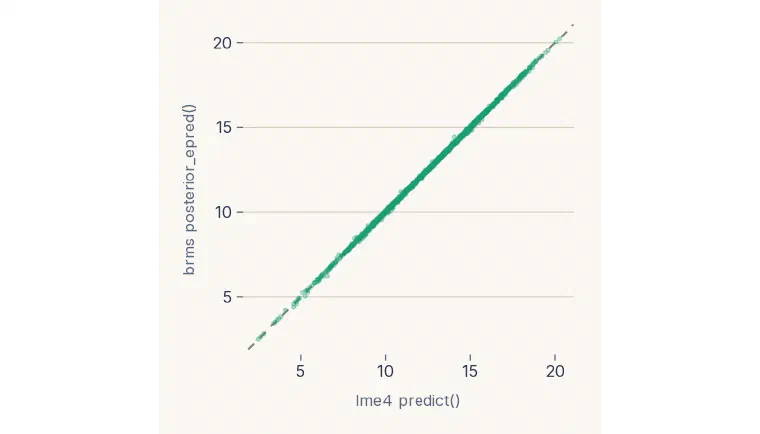
And they are equally well calibrated #
The real test is out-of-sample: do nominal intervals cover held-out scores at the
nominal rate? We draw a full predictive distribution for each held-out student
from each method — predictInterval(returnSims = TRUE) and
brms::posterior_predict() — and compare empirical coverage. Both track the
nominal level, and each other.
The mt_draws() helper used below — saved alongside the analysis — just wraps
predictInterval() to hand back the raw simulation matrix:
# One column of posterior-style draws per row of `newdata`.
mt_draws <- function(fit, newdata, ...) {
  pi <- predictInterval(fit, newdata = newdata, returnSims = TRUE, ...)
  attr(pi, "sim.results")
}
mt_seen <- mt_draws(m_lme, test_seen)
pp_seen <- posterior_predict(m_brm, newdata = test_seen, allow_new_levels = TRUE)
data.frame(nominal = NOMINAL,
merTools = coverage(mt_seen, test_seen$mathach, NOMINAL),
brms = coverage(pp_seen, test_seen$mathach, NOMINAL))#> nominal merTools brms
#> 1 0.50 0.4569776 0.4598698
#> 2 0.80 0.7895879 0.7932032
#> 3 0.90 0.9168474 0.9168474
#> 4 0.95 0.9660159 0.9703543At a fraction of the cost #
t_lme <- system.time(lmer(f1, data = train))[["elapsed"]]
t_mt  <- system.time(mt_draws(m_lme, test_seen))[["elapsed"]]
t_pp  <- system.time(posterior_predict(m_brm, newdata = test_seen,
                                       allow_new_levels = TRUE))[["elapsed"]]
data.frame(
  step = c("lme4 fit", "predictInterval", "brms fit (compile+sample)", "posterior_predict"),
  seconds = round(c(t_lme, t_mt, brms_fit_seconds, t_pp), 2))
#> step seconds
#> 1 lme4 fit 0.07
#> 2 predictInterval 0.66
#> 3 brms fit (compile+sample) 409.13
#> 4 posterior_predict 2.38The entire lme4 + predictInterval() path runs in about a second; the single
brms fit takes several minutes — a couple of orders of magnitude, and the gap
only widens on the large models predictInterval() was really built for. The
point isn’t to stop using brms: if you want the full posterior, use it. The point
is that when full MCMC is impractical, predictInterval() is a fast,
well-calibrated stand-in. The full story — new-group handling and a binomial GLMM
— is in the
validation vignette
.
When full MCMC is impractical, predictInterval() is a fast, well-calibrated stand-in.
Visualizing group effects with plotREimpact()
#
New in 1.0, plotREimpact() visualizes REimpact() output — the fitted outcome
across the distribution of a grouping factor’s effect. Pass a named list and it
overlays grouping factors on shared axes, so you can compare their influence
directly. Here, the instructor and student effects in the InstEval ratings data:
m1 <- lmer(y ~ service + lectage + studage + (1 | d) + (1 | s), data = InstEval)
imp_d <- REimpact(m1, InstEval[7, ], groupFctr = "d", breaks = 5, n.sims = 300, level = 0.9)
imp_s <- REimpact(m1, InstEval[7, ], groupFctr = "s", breaks = 5, n.sims = 300, level = 0.9)
plotREimpact(list("Instructor (d)" = imp_d, "Student (s)" = imp_s)) + theme_civilytics()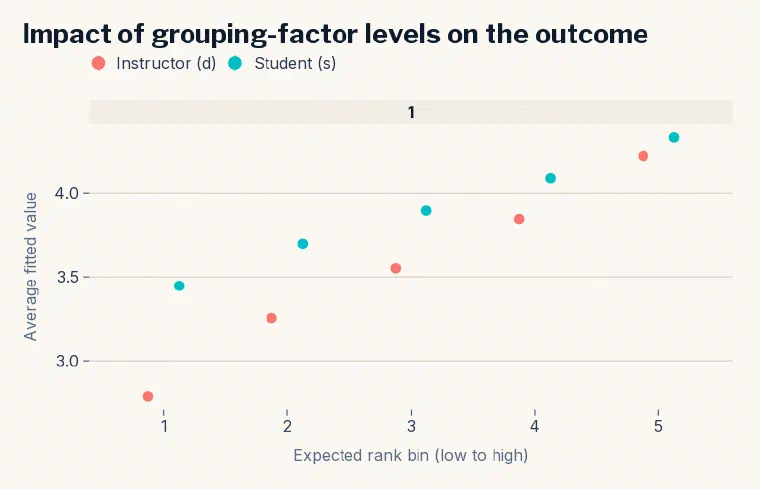
Moving a case from the bottom to the top of the instructor-effect distribution shifts the predicted rating substantially more than the same move across the student distribution — the instructor grouping factor carries more of the signal.
What else is new in 1.0 #
The release notes have the full list; the highlights:
Correctness fix for nested random effects (#124).
predictInterval()was returning seed-dependent point estimates when a prediction frame mixed observed and unobserved levels of an interaction grouping factor (e.g.(1 | a/b)). Amax.col()tie-break was silently letting an unobserved level borrow a random observed level’s effect. Unobserved levels now correctly fall back to the fixed effects; observed-level predictions are bit-for-bit unchanged.New
new.levels = "draw". For a group the model never saw, the default ("zero") drops its random effect;"draw"instead samples the effect from the estimated random-effect covariance — the direct analogue ofbrms::posterior_predict(allow_new_levels = TRUE). The default is unchanged.plotFEsim()now highlights significant terms, andshinyMer()is revived and extended with a Model Summary tab and subset-based draws.
Why LTS / maintenance mode #
merTools does what it set out to do, and the API has been stable for years. Going forward, 1.0.x releases will be about keeping it healthy — bug fixes, CRAN and dependency compatibility, and documentation — rather than churning the interface.
Get it / cite it / file issues #
install.packages("merTools")
citation("merTools")- Package site & vignettes: https://jknowles.github.io/merTools/
- Source & issues: https://github.com/jknowles/merTools
Thanks to everyone who has contributed over the years — Carl Frederick, Alex
Whitworth, Ben Bolker (@bbolker), Davis Vaughan (@DavisVaughan) — and to the
issue reporters who made this release better, including @dotPiano, whose report
led to the #124 correctness fix.
References #
- Knowles & Frederick (2026)
- Knowles, J. & Frederick, C. (2026). merTools: Tools for analyzing mixed effect regression models. Retrieved from https://cran.r-project.org/package=merTools
- Gelman & Hill (2007)
- Gelman, A. & Hill, J. (2007). Data analysis using regression and multilevel/hierarchical models. Cambridge University Press.
Gelman & Hill, Data Analysis Using Regression and Multilevel/Hierarchical Models (Cambridge University Press, 2007), ch. 12 — the simulation approach
predictInterval()implements. ↩︎